CELPIP Speaking Task 4: Making Predictions
You see the same picture as in Task 3 and say what you think will happen next.
Checked against celpip.ca
How to structure a Task 4 answer
- Say briefly what is happening now.
- Make two or three predictions, each tied to something you can see in the picture.
- Explain why you think so.
Tip: Try a few future forms, such as "will", "is going to", "will probably" and "might", instead of "will" in every sentence.
- 30s to prepare
- 60s to speak
What does a Task 4 answer look like?
The prompt and the answer are our own, written in the style of the real test. They are not an official question or an official sample answer.
Prompt
In this picture, what do you think will probably happen next?
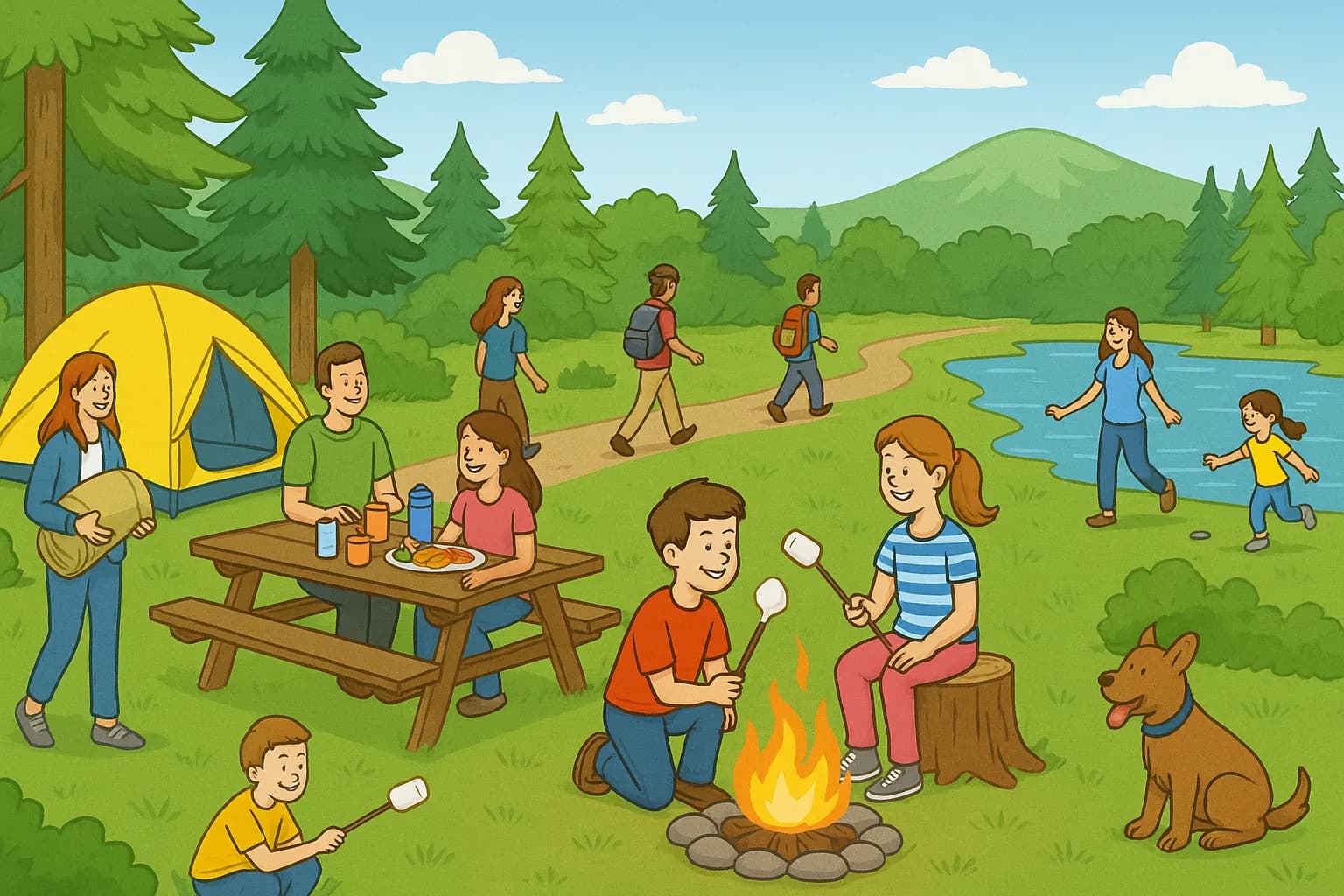
Our sample answer - 117 words, about 58 of the 60 seconds
Based on what I see, this family is going to have a fun evening at the campsite. First, I think the boy in the red T-shirt will burn his marshmallow, because he's holding it very close to the flames. He'll probably laugh and put a new one on his stick. Second, the brown dog on the right might try to steal some food. He's watching the kids closely, so if anyone drops a marshmallow, he's going to grab it. Third, since the woman next to the yellow tent is holding a sleeping bag, I predict she'll put it inside soon and get the beds ready before dark. After that, everyone will probably sit around the fire together.
The AI feedback this answer got
The same AI review you get after practice, as it came back. The AI read the answer as text (about 58 seconds spoken), so Listenability here is about the words, not pronunciation or pace.
All levels are our AI's estimate, not an official CELPIP score. The level meaning beside the score follows celpip.ca; level descriptions inside the feedback come from our own rubric.
Speaking score
Likely between 8 and 10
AI practice estimate, not an official score
What worked, and how to move up
What worked
Listenability (10/12)
- You use accurate clause structure in lines like "because he's holding it very close to the flames" and "since the woman next to the yellow tent is holding a sleeping bag."
- The response is fully understandable, with no visible hesitation problems and a good mix of simple and complex sentences.
How to move up a level
- Vocabulary: replace a few basic verbs and adjectives with sharper scene-specific choices, such as carry, gather, likely, and relaxed.
- Coherence: add one more layer of development to each prediction so the listener hears prediction, reason, and outcome, not just the first two steps.
- Task Fulfillment: keep the same structure, but make the closing slightly more complete by showing what the group will do after they sit down.
The AI's rewritten version
Based on what I see, this family is likely to enjoy a calm evening at the campsite. First, the boy in the red T-shirt will probably burn his marshmallow, because he is holding it very close to the flames. He may laugh, pull it back, and try again with a fresh one. Second, the brown dog on the right could wander over and try to grab a snack if someone leaves food unattended. Third, since the woman beside the yellow tent is carrying a sleeping bag, she is probably going to take it into the tent and get everything ready before dark. After that, the group will likely gather around the fire, finish their food, and settle in for the night.
Feedback by dimension
Content / Coherence
9/12This is a clear, well-organized prediction response with three distinct ideas and a brief wrap-up. The ideas are supported with specific visual evidence, which keeps the listener oriented throughout.
What You Did Well
- "the boy in the red T-shirt will burn his marshmallow" - this is a concrete prediction tied to what is happening in the picture.
- "because he's holding it very close to the flames" - you gave a reason, not just a guess.
- "the brown dog on the right might try to steal some food" - this adds another distinct prediction and shows you are tracking different parts of the scene.
- "I predict she'll put it inside soon and get the beds ready before dark" - this is developed with a clear cause-and-effect idea.
What to Work On
- Add a little more depth to one or two predictions:
- Make the conclusion slightly more specific:
To Reach 10/12
- Build each prediction with one more detail so the response feels thoroughly developed rather than briefly supported.
- Add a stronger closing that shows the likely result of the scene, not just the next action.
Next Steps
- Practice a 3-part pattern: prediction, reason, and likely result.
- For each image, make sure at least one prediction includes a clear chain such as observation → action → outcome.
Vocabulary
8/12You use clear, accurate vocabulary that fits the picture well, and you include some more specific words such as "marshmallow," "campsite," and "sleeping bag." The range is solid, but most of the language stays in common, everyday wording, so it does not quite reach the broader precision expected at the next level.
What You Did Well
- "campsite" - this is a precise, context-specific word that fits the scene naturally.
- "sleeping bag" - another accurate, task-appropriate phrase.
- "steal some food" - this is clear and natural for the dog prediction.
- "get the beds ready before dark" - this shows you can use scene-based vocabulary to explain what may happen next.
What to Work On
- Use more precise predictive language:
- Replace basic action verbs with more vivid ones:
- Add one or two higher-level descriptive phrases:
To Reach 9/12
- Use a wider mix of context-specific vocabulary and more exact future expressions.
- Keep the language natural, but choose words that show sharper precision and less reliance on common phrasing.
Next Steps
- Practice replacing common verbs like "go," "get," and "put" with more exact alternatives that fit the scene.
- Build a small prediction word bank: likely to, expected to, gather, carry, retreat, settle in.
Listenability
10/12Graded from the transcript only: the AI cannot hear your voice.
GRAMMAR & SENTENCE STRUCTURE
Found 0 grammar issues.
PACE & PAUSING
Word count: 117 words; Speaking rate: 121 words per minute; Fillers: 0 (0% of words); Pauses: 0 short [.], 0 medium [..], 0 long [...]. This is comfortably fluent, and there are no transcript signs of hesitation that would limit the score. The response also uses a mix of simple and complex structures, such as "because he's holding it very close to the flames" and "since the woman next to the yellow tent is holding a sleeping bag."
STYLE & SENTENCE VARIETY
Your sentence structure is varied and easy to follow. You move from an opening statement to numbered predictions and then to a closing summary, which keeps the delivery organized. The main opportunity is not accuracy, but slightly richer sentence variety so the response feels less patterned.
What You Did Well
- "Based on what I see" - a clear opening that fits the task.
- "because he's holding it very close to the flames" - a well-formed reason clause.
- "since the woman next to the yellow tent is holding a sleeping bag" - a more complex sentence structure that works well.
- "After that, everyone will probably sit around the fire together" - a clean concluding sentence.
What to Work On
- Add one or two more varied sentence openings:
Consider: "First, I think..." / "Second, the dog might..." / "In addition, the woman could..." → this would make the response feel less list-like.
- Use a slightly broader mix of complex structures:
Consider: adding a sentence with "while," "although," or "as" to connect two ideas in one thought.
To Reach 11/12
- Maintain the same accuracy, but add a wider range of complex sentence patterns across the whole response.
- Keep extending ideas with varied clause types so the structure feels more flexible and less formulaic.
Next Steps
- Practice speaking 3 predictions using different connectors: because, since, while, and after.
- Record a short response and check whether each sentence starts in a different way.
Task Fulfillment
9/12The response fully addresses the prompt and stays on task throughout. It gives three clear predictions, ties them to the picture, and ends with a suitable summary. The length is also strong for a 60-second task, so there is no length penalty.
Task Requirements Check
- Brief reference to the current scene ✓ "Based on what I see"
- State prediction ✓ "this family is going to have a fun evening at the campsite"
- Explain reasoning ✓ "because he's holding it very close to the flames"
- Discuss implications ✓ "After that, everyone will probably sit around the fire together"
- 2-3 distinct predictions ✓ three predictions are given
- Prediction linked to visual evidence ✓ each main prediction is tied to a visible detail
- Appropriate analytical tone ✓ confident and balanced
- 60-second length target ✓ 117 words, which fits the target well
What You Did Well
- "First, I think the boy in the red T-shirt will burn his marshmallow" - clear and direct prediction.
- "Second, the brown dog on the right might try to steal some food" - another relevant prediction that follows the image.
- "Third, since the woman next to the yellow tent is holding a sleeping bag" - strong use of visual evidence.
- "After that, everyone will probably sit around the fire together" - a fitting closing statement.
What to Work On
- Push the implications a little further:
- Make at least one prediction feel more exploratory:
To Reach 10/12
- Develop each prediction with a fuller explanation of what is likely to happen next.
- Add one more step in the outcome so the ending feels more complete and less brief.
Next Steps
- Use a quick planning formula before speaking: scene detail → prediction → reason → result.
- For each prediction, ask yourself, “What happens next, and what happens after that?”
Why this score
WHY THIS SCORE
Coherence 9, Vocabulary 8, Listenability 10, Task Fulfillment 9. Listenability is the strongest dimension here, while vocabulary is the main reason the response does not move higher. The content is solid and task-appropriate, and there is no length penalty because 117 words fits the 60-second target.
YOUR WEAKEST DIMENSION
Vocabulary (8/12)
- What held you back is that much of the wording stays common and predictable, for example "have a fun evening," "put it inside soon," and "sit around the fire together."
- The next level up requires "Common and context-specific vocabulary" used naturally and accurately, with stronger precision and a wider range.
WHAT LEVEL 9+ LOOKS LIKE
- More precise, context-specific wording than "have a fun evening" and "put it inside soon," so the language feels less generic.
- A fuller explanation of the likely outcome, not just a final action like "sit around the fire together."
- Slightly richer development in each prediction so the response sounds more thoroughly built out rather than simply clear.
Words to learn
probable or expected to happen
Instead of 'will probably', try: 'The family is likely to enjoy a calm evening at the campsite.'
move around without a fixed direction
Instead of 'try to steal some food', try: 'The brown dog could wander over and try to grab a snack if someone leaves food unattended.'
not being watched or looked after
Instead of 'if anyone drops a marshmallow', try: 'if someone leaves food unattended.'
Task 4 answers at other levels
We answered the same prompt at other levels. Each answer shows the level our AI review gave it, and why. Compare them with the answer above to see what moves an answer up.
Level 7 answer
97 words, about 48 seconds. Level from our AI review, not an official score.
I think, um, the boy with the red shirt, his marshmallow will burn, because it's very close to the fire. Then he will be sad, maybe. And the dog, I think the dog will go to the table, because there is food on the table and he is hungry. Uh, the woman with the sleeping bag, she will go in the tent and put the bag inside. The people who walking on the road will go to the lake, maybe for swimming. Later everybody will eat the dinner together. It will be a nice evening for them.
The response is clear and on task, but it stays in a fairly simple pattern and the ideas are only lightly developed. Listenability is held back by a few grammar errors and by repeated sentence structure, while Task Fulfillment is solid but not especially detailed.
We changed "one grammar error" to "a few grammar errors": the answer has more than one.
Level 8 answer
130 words, about 58 seconds. Level from our AI review, not an official score.
Looking at this picture, I think a few things are going to happen soon. First, the little girl in the yellow shirt is running really fast near the lake, and her mom is chasing her. I think the girl will run right to the edge and get her shoes wet, so her mom will have to take her back to the tent to change. Second, there's a plate of food on the picnic table, so the man will probably call the kids over to eat. They'll bring their marshmallows to the table as dessert. Also, the hikers on the path look like they're just starting their walk, so they'll be gone for a couple of hours. Finally, when it gets dark, the whole family will sit around the campfire together.
Listenability is the strongest area; the main limit is that the ideas are clear but not developed enough for a higher coherence score, and the vocabulary stays accurate but fairly familiar. The response is complete and on-task, so nothing is seriously holding it back.
For official answers at each level, with the raters' notes, see Paragon's Score Comparison Chart.
Questions learners ask
You get 30 seconds to prepare and 60 seconds to speak. Our practice uses the same times.
There is no word count, only the time. The official scored sample answers for this task were between 93 and 172 words, counting fillers like "um". Aim to fill the time with clear ideas, not to hit a number.
On what you can see. The study pack’s key strategy is to tie each prediction to the picture, which is the same picture as in Task 3.
Raters score it on four areas: Content/Coherence, Vocabulary, Listenability and Task Fulfillment. The levels on this page come from our AI review: an estimate, not an official score.
EnvolPrep is not affiliated with Paragon Testing Enterprises, Prometric or IRCC.