CELPIP Speaking Task 3: Describing a Scene
You are shown a picture and describe what you see, as if to someone who cannot see it.
Checked against celpip.ca
How to structure a Task 3 answer
- Start wide: where this is and what is happening overall.
- Then move to the details, in a fixed order: front to back, or left to right.
- Finish with the mood of the scene.
Tip: Pick a direction and stay with it, so the listener can follow you around the picture.
- 30s to prepare
- 60s to speak
What does a Task 3 answer look like?
The prompt and the answer are our own, written in the style of the real test. They are not an official question or an official sample answer.
Prompt
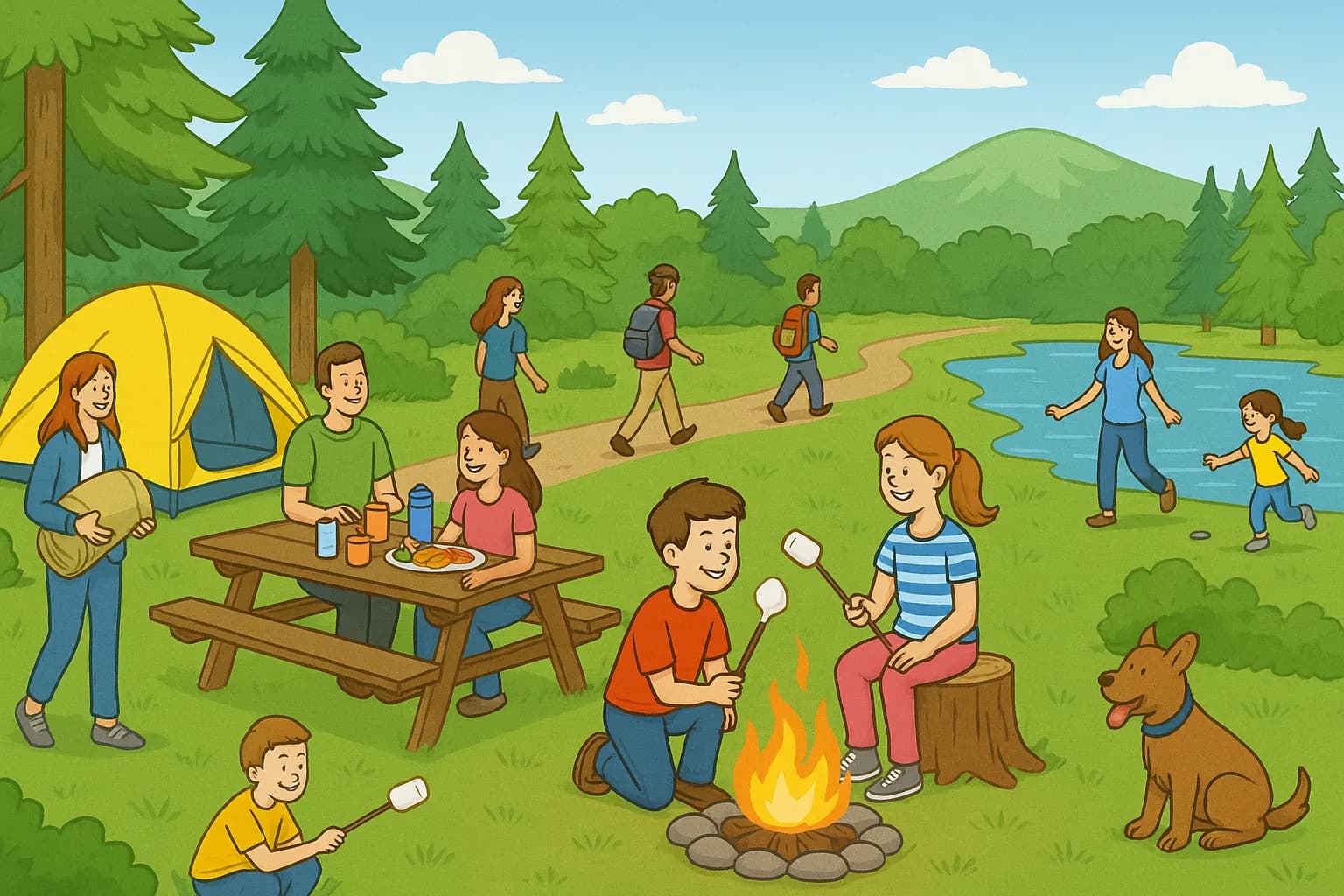
Describe some things that are happening in the picture below as well as you can. The person with whom you are speaking cannot see the picture.
Our sample answer - 119 words, about 60 of the 60 seconds
This picture shows a family campsite in the woods on a sunny day. In the foreground, right in the centre, there's a small campfire inside a ring of stones. A boy in a red T-shirt is kneeling next to it and roasting a marshmallow, and a girl in a striped shirt is sitting on a tree stump beside him. On the left, two people are sitting at a picnic table, and a woman is holding a sleeping bag near a yellow tent. On the right, a brown dog is watching the kids. In the background, three hikers are walking along a dirt path, and a little girl is running beside a lake. The whole scene feels relaxed and happy.
The AI feedback this answer got
The same AI review you get after practice, as it came back. The AI read the answer as text (about 60 seconds spoken), so Listenability here is about the words, not pronunciation or pace.
All levels are our AI's estimate, not an official CELPIP score. The level meaning beside the score follows celpip.ca; level descriptions inside the feedback come from our own rubric.
Speaking score
Likely between 7 and 9
AI practice estimate, not an official score
What worked, and how to move up
What worked
Listenability (9/12)
- "This picture shows a family campsite in the woods on a sunny day." and "The whole scene feels relaxed and happy." are both clean, well-formed sentences that show strong sentence control.
- The transcript also shows 0 fillers and 0 pauses, so the delivery is smooth by evidence.
How to move up a level
- Coherence: For each main part of the picture, add one supporting detail that explains the scene a little more, such as what makes the area busy, calm, or interesting.
- Vocabulary: Replace one or two basic scene words with more precise alternatives, especially for mood and setting, so the description feels more vivid.
- Listenability: Keep using the same accurate sentence control, but practice mixing one longer sentence with a few shorter ones.
- Task Fulfillment: You already covered the task well; keep the opening and closing, and add one extra layer of detail to make the picture feel fuller.
The AI's rewritten version
This picture shows a lively family campsite in the woods on a bright afternoon. In the foreground, a campfire is burning inside a ring of stones, and a boy in a red T-shirt is kneeling beside it, carefully roasting a marshmallow. Next to him, a girl in a striped shirt is sitting on a tree stump and smiling. On the left, a woman is holding a sleeping bag near a yellow tent, while two people are sitting at a picnic table and enjoying their meal. In the background, three hikers are walking along a dirt path, and farther away, a little girl is running beside a lake. On the right, a brown dog is watching the children. Overall, the scene feels peaceful, cheerful, and full of activity.
Feedback by dimension
Content / Coherence
8/12This is a clear, easy-to-follow scene description with a strong general opening and several concrete details. It reaches Level 8 because the ideas are organized and specific, but the development stays fairly brief rather than fully expanded.
What You Did Well
- "This picture shows a family campsite in the woods on a sunny day." - This gives a clear overview right away and sets the scene well.
- "In the foreground, right in the centre, there's a small campfire inside a ring of stones." - This is a strong spatial description with precise scene-setting detail.
- "On the left" / "On the right" / "In the background" - These markers help the listener visualize where things are.
- "The whole scene feels relaxed and happy." - This adds a simple atmosphere comment, which is important for this task.
What to Work On
- Development of ideas:
- Background detail:
To Reach 9/12
- Develop at least one or two of your scene details with an extra layer of information, instead of moving immediately to the next object or person.
- Keep the same clear spatial organization, but add a little more depth so the listener can picture the relationships between the people and the setting more vividly.
Next Steps
- Practice the pattern: overview → foreground → left side → right side → background → atmosphere.
- For each main detail, ask yourself, "What else is happening here?" and add one short supporting phrase.
Vocabulary
8/12Your vocabulary is solid and appropriate for a picture description. You use some context-specific words naturally, but the range stays in the common-to-moderately-specific band rather than moving into more precise or vivid language.
What You Did Well
- "family campsite" - This is a precise, task-appropriate phrase.
- "foreground," "centre," "background" - These are strong scene-description words and show good control of spatial language.
- "campfire," "picnic table," "sleeping bag," "hikers" - These are accurate, relevant nouns that fit the picture well.
- "relaxed and happy" - This is a clear and natural way to describe the mood.
What to Work On
- More vivid descriptive language:
- More precise atmosphere wording:
- Broader range of descriptive verbs:
To Reach 9/12
- Replace a few basic scene words with more precise, natural alternatives that create a stronger visual impression.
- Add one or two richer verbs or adjectives so the description sounds less like a list and more like a vivid scene.
Next Steps
- Build a small bank of scene words for weather, mood, and movement, then practice using them in picture descriptions.
- When you describe a picture, challenge yourself to use one more exact adjective and one more varied verb than last time.
Listenability
9/12Graded from the transcript only: the AI cannot hear your voice.
This is a strong, fluent response with excellent control of basic sentence structure and no visible hesitation problems in the transcript. The grammar is accurate overall, and the sentence variety is enough to keep the description clear and natural.
GRAMMAR & SENTENCE STRUCTURE
Found 0 grammar issues.
What You Did Well
- "This picture shows a family campsite in the woods on a sunny day." - This is a complete, well-formed opening sentence.
- "there's a small campfire inside a ring of stones" - This shows accurate sentence structure with a clear prepositional phrase.
- "three hikers are walking along a dirt path" - This is a correct present continuous structure, which suits the task well.
- "The whole scene feels relaxed and happy." - This is a clean concluding sentence with correct grammar.
What to Work On
- Sentence variety:
Consider: "A boy in a red T-shirt is kneeling next to it and roasting a marshmallow" → break one long detail into two linked sentences for a slightly more flexible rhythm.
→ Why: The response is accurate, but several ideas are packed into similar sentence patterns.
- Descriptive layering:
Consider: "On the left... On the right... In the background..." → vary one of the transitions with a fuller linking phrase, such as "Farther back" or "Across the scene."
→ Why: A bit more variation in structure would make the delivery feel more dynamic.
PACE & PAUSING
Measured delivery: 119 words, 119 words per minute, 0 fillers, 0% fillers, 0 short pauses, 0 medium pauses, 0 long pauses.
This is fluent delivery by transcript evidence, and there is no sign of hesitation that would limit understanding.
STYLE & SENTENCE VARIETY
The response relies mostly on clear simple and compound sentences, which works well for this task. To move higher, you could mix in a few more varied structures while keeping the same accuracy.
What You Did Well
- The response stays easy to follow from start to finish.
- The sentence patterns are controlled and accurate.
What to Work On
- Add one or two more varied sentence shapes so the description does not feel built from the same pattern each time.
- Use a slightly wider mix of linking phrases to connect the scene more smoothly.
To Reach 10/12
- Keep the same accuracy, but add more variety in clause structure and linking so the description sounds more flexible and less patterned.
- Use one or two longer descriptive sentences alongside the shorter ones.
Next Steps
- Practice describing one picture twice: once with short sentences, once with mixed-length sentences.
- Record yourself and check whether you are using the same sentence shape too often.
Task Fulfillment
9/12You address all of the main requirements for this task very well. The scene is described directly, the listener gets a clear picture, and the tone matches a descriptive picture task.
Task Requirements Check
- Describe some things that are happening in the picture - met ✓
- Make the description understandable to someone who cannot see the picture - met ✓
- Use an appropriate descriptive tone - met ✓
- Include a clear opening and closing - met ✓
- Stay relevant to the picture - met ✓
- Use about 60 seconds of speaking time - met ✓
What You Did Well
- "This picture shows a family campsite in the woods on a sunny day." - A strong opening that immediately orients the listener.
- "In the foreground, right in the centre..." - This shows clear attention to the task’s visual description purpose.
- "The whole scene feels relaxed and happy." - This is an effective closing that adds mood.
- The response stays fully focused on the picture and does not drift away from the task.
What to Work On
- Nothing major is missing. The main opportunity is to make the scene feel a little more fully developed.
- A few details could be expanded so the description feels even more immersive.
To Reach 10/12
- Add one more layer of scene detail, especially around the people or the background, so the description feels more complete and vivid.
- Keep the same direct, descriptive tone while making the picture feel slightly more three-dimensional.
Next Steps
- Use a quick mental checklist before speaking: opening, foreground, left side, right side, background, mood.
- After each main detail, add one short extra phrase that helps the listener picture the scene more clearly.
Why this score
WHY THIS SCORE
Coherence 8, Vocabulary 8, Listenability 9, Task Fulfillment 9. The response is strong overall, but Coherence and Vocabulary stay just below the next level because the ideas are clear yet only lightly developed, and the word choice is accurate but not especially vivid. Listenability is a strength: the transcript shows no fillers or pauses, and the grammar is controlled.
YOUR WEAKEST DIMENSION
Coherence (8/12)
- What held you back is that several ideas are presented clearly but briefly, such as "A boy in a red T-shirt is kneeling next to it and roasting a marshmallow" and "three hikers are walking along a dirt path."
- The next level requires "Ideas supported with moderately complex reasons" and developed details, not just a sequence of accurate scene elements.
WHAT LEVEL 9+ LOOKS LIKE
- More developed ideas with specific support, not just clear scene listing.
- More vivid and precise scene language, especially for mood and setting.
- A slightly wider range of sentence shapes so the description feels less patterned.
Words to learn
full of energy, colour, and life
Instead of "a family campsite," try: "This picture shows a vibrant family campsite in the woods."
attractive in a way that looks like a picture
Instead of "in the woods," try: "This picture shows a picturesque campsite in the woods."
calm and peaceful
Instead of "relaxed and happy," try: "The whole scene feels serene and cheerful."
Task 3 answers at other levels
We answered the same prompt at other levels. Each answer shows the level our AI review gave it, and why. Compare them with the answer above to see what moves an answer up.
Level 7 answer
96 words, about 50 seconds. Level from our AI review, not an official score.
In this picture, I see, um, a camping place. There is many trees and a lake. On the left there is a yellow tent, and a woman is holding, uh, a sleeping bag. Near her, a man and a girl is sitting at the table and they are eating. In the middle, two kids is making marshmallow on the fire. The boy has a red shirt and the girl is sitting on the wood. On the right side there is a dog, brown dog. In the back, some people is walking with backpack. Everybody look happy.
Listenability is the main factor holding the response down because of several grammar agreement errors, while the other dimensions are stronger but still not developed enough for a higher band.
Level 10 answer
148 words, about 60 seconds. Level from our AI review, not an official score.
This is a cheerful scene at a lakeside campsite on a bright summer day, surrounded by pine trees, with a green hill in the distance. Right in the centre of the foreground, a small campfire is burning inside a circle of grey stones. A boy in a red T-shirt is kneeling beside it, carefully holding out a marshmallow on a long stick, while a girl in a blue striped top does the same from a tree stump, and a younger boy in yellow crouches in the corner with one of his own. Behind them, a man and a girl are chatting at a wooden picnic table set with a plate of food and a blue water bottle. Further back, three hikers are heading along a winding trail, and by the lake a mother is chasing her little girl. A brown dog sits on the right, looking completely content.
The response is strong across all four areas, with clear organization, precise scene vocabulary, and fluent sentence control. Nothing is holding it back in a major way; the main difference from the very top band is that the description could add a little more nuance and depth.
For official answers at each level, with the raters' notes, see Paragon's Score Comparison Chart.
Questions learners ask
You get 30 seconds to prepare and 60 seconds to speak. Our practice uses the same times.
There is no word count, only the time. The official scored sample answers for this task were between 102 and 118 words, counting fillers like "um". Aim to fill the time with clear ideas, not to hit a number.
With the general scene, then move to the details. That is the study pack’s key strategy for this task.
Raters score it on four areas: Content/Coherence, Vocabulary, Listenability and Task Fulfillment. The levels on this page come from our AI review: an estimate, not an official score.
EnvolPrep is not affiliated with Paragon Testing Enterprises, Prometric or IRCC.