
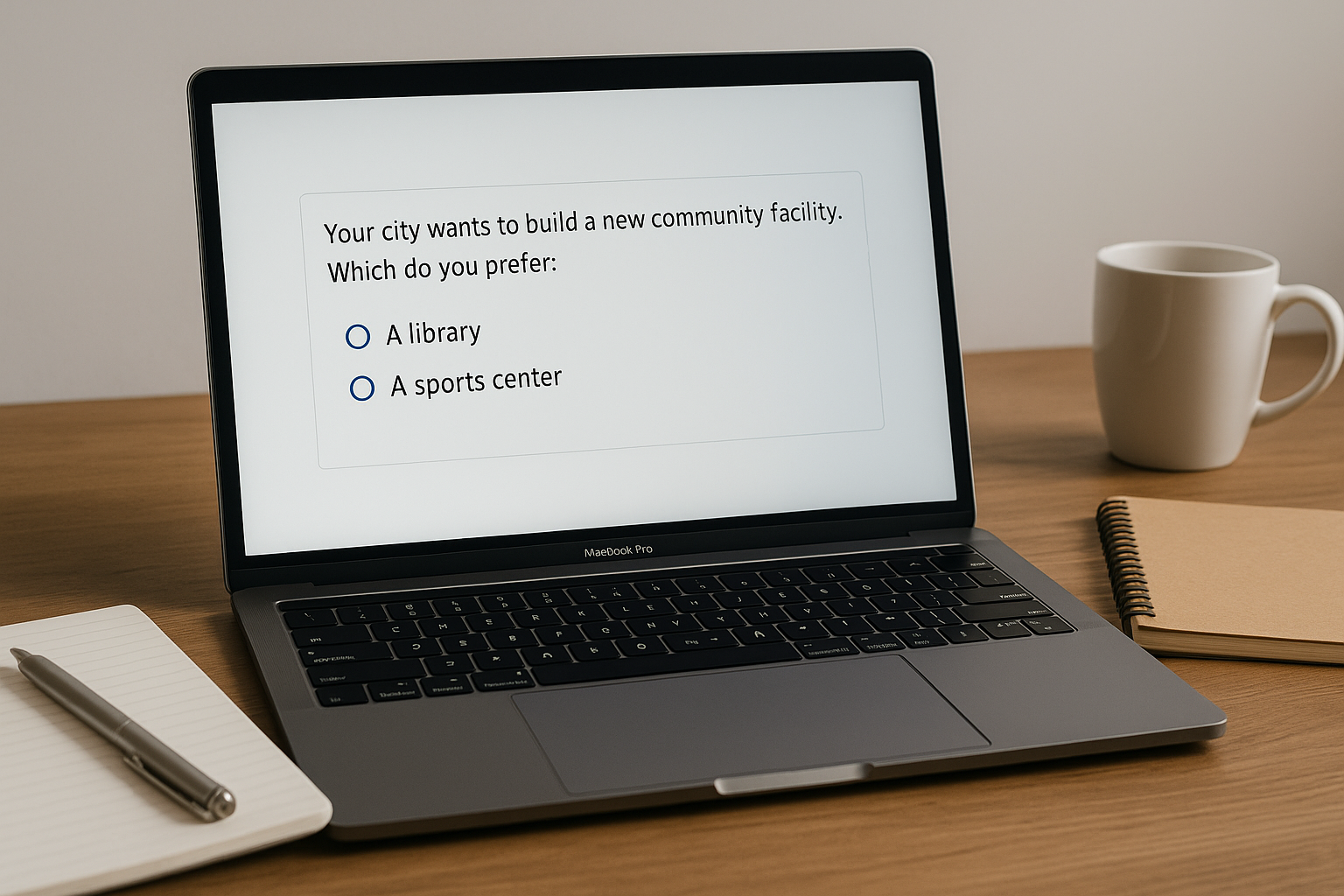
Writing Task 2 is the second part of the CELPIP Writing section. You are given a survey-style prompt with two options. Your job is to choose one option and write a clear, well-organized response explaining why you prefer it.
This task tests your ability to form an opinion, support it with reasons and examples, and write in a semi-formal to formal tone. This guide covers the format, scoring criteria, structure, and a sample answer.
Task Format
- Time: 26 minutes
- Word count: about 150-200 words (aim for about 180)
- What you do: Choose one of two options and explain your choice with reasons
- Tone: Semi-formal to formal (unlike Task 1, where the tone depends on who you write to)
You type your response on the computer. A word counter on screen helps you track your length. Write in full paragraphs. The official study pack says to avoid list or point form.
How Your Response Is Scored
Raters score your response in four official categories:
| Criteria | What Raters Look For |
|---|---|
| Task Fulfillment | Did you choose a clear side and support it with reasons? |
| Content/Coherence | Are your ideas clear, well organized and supported with specific examples? |
| Vocabulary | Did you use varied and appropriate words without repeating the same ones? |
| Readability | Are your grammar, spelling and punctuation correct? Do paragraphs and linking words make it easy to follow? |
Above all, make your choice clear and defend it. Writing about both options without choosing one will lower your score.
Response Structure
A strong Task 2 response has four paragraphs:
1. Introduction (2-3 sentences)
Restate the topic in your own words and clearly state which option you choose.
Example: "I strongly believe that our city should build a new public library instead of a sports center. A library would provide greater long-term value for the entire community."
2. Body Paragraph 1 - First Reason (3-4 sentences)
Give your strongest reason and support it with a specific example.
Example: "A library offers free access to educational resources. Many students in our city cannot afford to buy all the books they need. A library would give them a quiet space to study and access both printed and digital materials."
3. Body Paragraph 2 - Second Reason (3-4 sentences)
Give a second reason, also with a supporting example. Also compare your choice with the other option: briefly acknowledge it, then explain why yours is still better.
Example: "Admittedly, a sports center would promote physical fitness. However, a library serves people of all ages - seniors can enjoy reading programs, while children can attend storytelling sessions."
4. Conclusion (2-3 sentences)
Summarize your position and restate your choice.
Example: "For these reasons, a public library is a smarter investment for our community. It will encourage education and bring people together for years to come."
The "Admittedly... However..." Technique
The official study pack advises you to compare your choice to the other choice. A simple way to do this is to briefly acknowledge the other option, then explain why yours is better.
Use this structure:
- "Admittedly, [the other option] has some benefits, such as [brief advantage]."
- "However, [your option] is a better choice because [your reason]."
Keep this short - one or two sentences is enough. The focus of your response should remain on supporting your own choice, not analyzing the other option.
Tips for a High Score
1. Choose one side and commit to it
Do not try to argue for both options. Pick one and defend it throughout your entire response. Sitting on the fence will lower your score.
2. Plan before you write
Spend about 4 minutes planning, as the official study pack suggests (4-5 minutes). Write down your choice, two reasons, and one example for each. Then spend about 19 minutes writing and about 3 minutes reviewing.
3. Use linking words
Connect your ideas with transitions like Firstly, Moreover, In addition, For example, As a result, In conclusion. These improve the flow of your writing and show a range of language.
4. Give specific examples
Vague statements like "It would be good for the community" are weak. Specific examples like "High school students preparing for exams would benefit from quiet study areas" are much stronger.
5. Avoid repeating the same words
If you use the word "important" in one sentence, use a synonym like "essential," "valuable," or "significant" in the next. Raters notice when you repeat the same vocabulary.
6. Stay within the word count
Aim for about 180 words. Writing fewer than 150 words usually means your ideas are not developed enough. Writing much more than 200 wastes time and may introduce errors.
Sample Task and Response
Prompt:
Your city is planning to build a new community facility. The two options being considered are a public library or a sports center. Some residents believe a library will provide more long-term benefits, while others think a sports center will promote health and fitness.
Choose the option that you prefer. Why do you prefer your choice? Explain the reasons for your choice. Write about 150-200 words.
- Option A: Build a public library
- Option B: Build a sports center
Sample Response (Option A):
I strongly believe that our city should build a new public library instead of a sports center. While promoting fitness is important, a library provides greater long-term value for the entire community.
Firstly, a library offers free access to knowledge and educational resources. Many students and young professionals in our city cannot afford to buy all the books they need. A library would give them a place to study, research, and access both printed and digital materials. For example, high school students preparing for exams would benefit tremendously from quiet study areas and online resources.
Secondly, a library is inclusive for people of all ages. Admittedly, a sports center would encourage physical activity. However, a library serves a wider audience - seniors can enjoy reading programs and community events, while children can participate in storytelling sessions.
In conclusion, a public library is a smarter investment for our community. It will encourage education, bring people together, and provide opportunities for lifelong learning.
Why this works: The response takes a clear position from the first sentence. Each body paragraph has a reason supported by a specific example. The second paragraph uses the "Admittedly... However..." technique. The conclusion restates the opinion. The tone is formal throughout.
Common Mistakes to Avoid
| Mistake | Why It Hurts Your Score | What to Do Instead |
|---|---|---|
| Not choosing a clear side | Raters want a definite opinion, not a balanced analysis | Pick one option in your introduction and stick to it |
| Using bullet points | The official study pack says to avoid list or point form | Write full paragraphs with complete sentences |
| Repeating the same words | Shows limited vocabulary range | Use synonyms - "important, essential, valuable, significant" |
| Giving vague reasons | Weak arguments lower your content score | Support each reason with a specific, real-world example |
| Writing too few words | Suggests your ideas are underdeveloped | Aim for about 180 words |
| Skipping the review | Small grammar and spelling errors add up | Save about 3 minutes at the end to proofread |
Quick Summary
- Task 2 gives you 26 minutes to write a 150-200 word response in a semi-formal to formal tone
- Choose one of two options and defend it with clear reasons and examples
- Structure: introduction, two body paragraphs (one reason each), conclusion
- Use the "Admittedly... However..." technique to acknowledge the other side briefly
- Write in paragraphs and avoid bullet points
- Plan for about 4 minutes, write for about 19 minutes, review for about 3 minutes
Start Practicing
The best way to improve your opinion writing is through regular practice. Try our CELPIP-style writing practice and get AI feedback on your arguments, vocabulary and grammar. Practice needs a free account. AI feedback on Writing and Speaking is free up to a daily limit.